


Piloting of General Education Quality Assessment
In February 2024, the piloting of the general education quality assessment model and quality criteria commenced. Quality assessment in general education is a formative evaluation aimed at empowering educational institutions to continuously and evidence-basedly develop learning environments that support the development of every learner. The assessment is based on the institution’s self-analysis and the resulting feedback from independent external experts, and it relies on quality agreements, i.e. quality criteria. The key output of the quality assessment is a school improvement action plan, which is discussed in a roundtable format together with the school owner, experts and HAKA representatives.
Based on the feedback collected during the pilot and the continuous refinement of the model, a general education quality agreement (including the quality criteria) that meets the expectations and needs of schools, school owners, and the government will be formulated. A total of 35 Estonian schools are participating in the pilot.
Main activities
- Schools applying to the pilot;
- Participation in self-analysis training sessions;
- Conducting self-analysis at the educational institution and agreeing on the assessment schedule and the composition of the assessment team;
- Review of the self-analysis report by assessment experts;
- School visit;
- Preparation of the initial assessment report by the experts;
- Feedback on the assessment report by the educational institution and preparation of a preliminary improvement action plan;
- Submission of the final assessment report to the school and the school owner;
- Roundtable discussion on improvement actions and follow-up activities.
*The listed activities will take around 1 year to complete.
Key benefits of Quality Assessment
Comprehensive overview of school strengths and areas for improvement
Self-analysis combined with external feedback provides schools with an objective and detailed view of their activities and outcomes. This helps schools clearly understand which areas are strong and which need improvement, essentially showing them where they stand and where they need to go.
Schools in Viljandi County participating in the pilot’s second phase highlighted the following benefits of the quality assessment during the self-analysis training: reviewing the system (are we collecting the right data?), aligning and focusing on goals and priorities, supporting the creation of new development plans, simplifying teachers’ work, and strengthening and motivating the school team.
Professional feedback and recommendations
Through external feedback, schools receive in-depth guidance from independent experts, forming the basis for their improvement action plans. This enables schools to make informed, evidence-based decisions for their future development.
Opportunity to involve a mentor
Schools can involve a mentor if desired. The mentor is an external expert who supports the self-analysis process, responding to the institution’s needs, providing guidance, and helping maintain focus.
Improvement action plan
At the end of the quality assessment, the school team develops a concrete action plan focused on improving the school, enhancing teaching processes, and strengthening school culture. The plan serves as a practical tool for the school.
Development of the school team and strengthening collaboration
The assessment process strengthens teamwork, as all stakeholders are involved in self-analysis, external evaluation, and planning improvement actions. This fosters unity and motivates the team to work together for school development.
Risti School’s master teacher, Marge Matson, notes: “Quality assessment provides a systematic framework, helping the school analyze its strengths and development needs consciously. In daily work, a teacher’s focus may remain narrowly on their class or subject area, but the assessment model helps to see the bigger picture of how school culture, curriculum, and support for learner development are interconnected.”

Reflecting on the school before and after the quality assessment, Matson adds: “We have a wonderful small community school that values continuity, creativity, and innovation. We have collectively reflected on our school’s values, linked them to teaching, and embedded them in our collaborative work. The assessment clearly highlighted that school culture begins with everyday attitudes and decisions. It confirmed that we are a value-driven school while also providing insights on how to make these values more visible to students in the physical environment. Supporting learners is central to our school, and we have created a wide range of options for this. The assessment recognized our teachers’ and support staff’s collaboration in addressing learners’ individual needs and fostering holistic development.”
“Quality assessment confirmed my sense that our school is moving in the right direction—collaboratively, valuing learner development and teacher professionalism,” adds the master teacher.
In summary, schools gain valuable knowledge, experience, and practical tools from general education quality assessment, helping them improve educational quality and create better learning opportunities for their students.
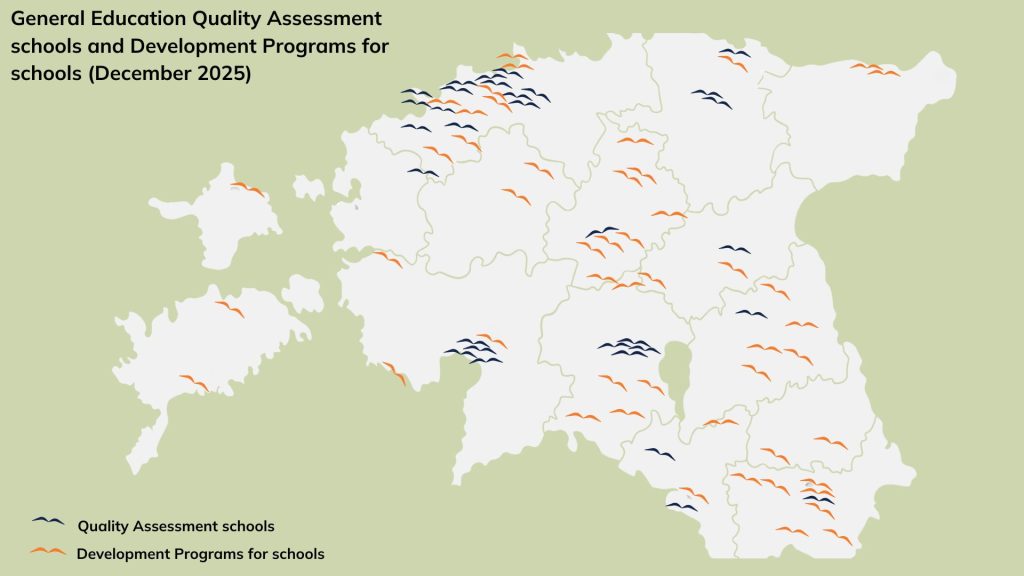
General education schools that have participated in Quality Assessment are marked in blue (as of December 2025).